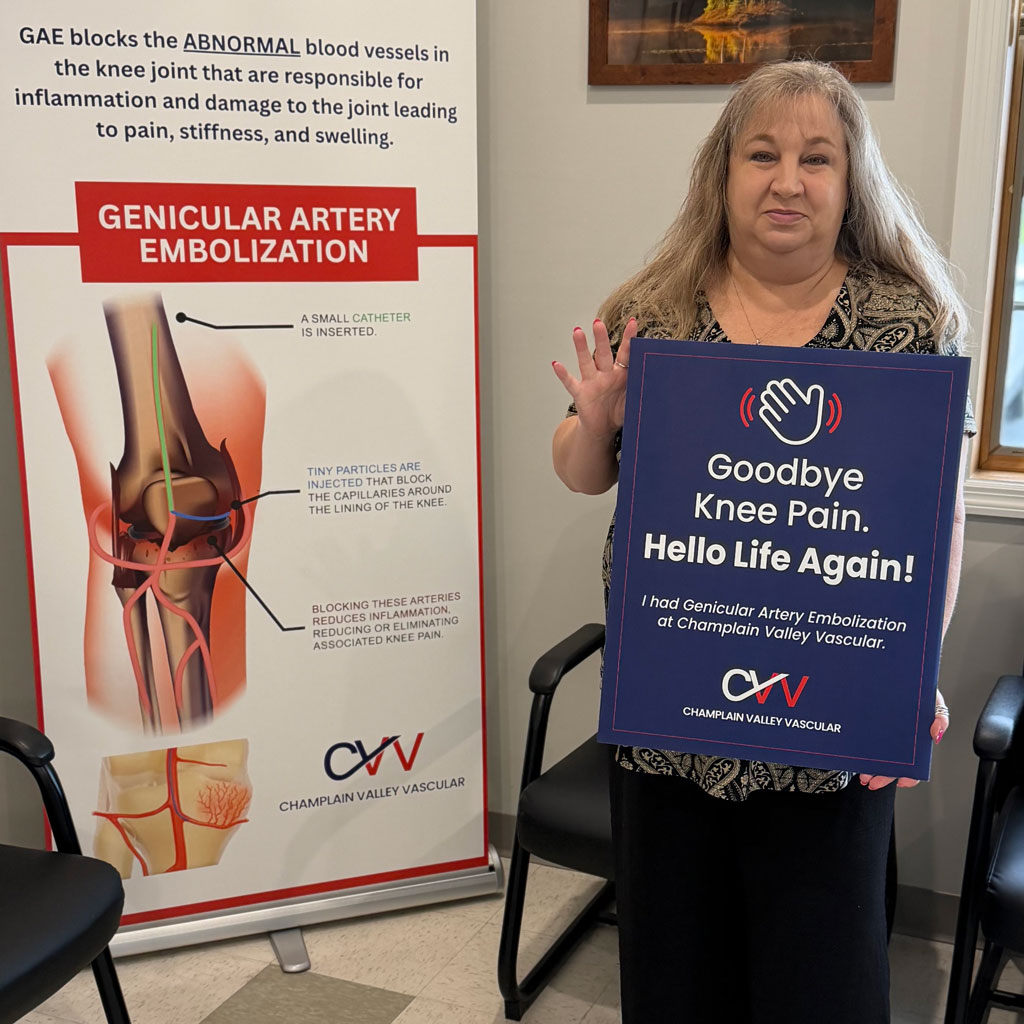

From Frustration to Function: Lisa’s Journey After Genicular Artery Embolization (GAE)
For years, Lisa struggled with chronic, debilitating knee pain that impacted nearly every part of her life. After undergoing a left total knee replacement in 2022, she hoped she would finally regain her mobility and independence. Unfortunately, despite surgery, Lisa continued to experience significant pain. Even after undergoing a revision surgery two years later, the pain persisted. At times, her knee pain reached an 8 out of 10. Simple daily activities became frustrating. Walking upstairs was difficult. Her mobility changed. Her quality of life declined.
Like many patients living with chronic knee pain after a total knee replacement, Lisa felt discouraged.
Looking Beyond the X-Ray
Despite her ongoing symptoms, radiographic imaging showed that Lisa’s total knee replacement appeared appropriately positioned without mechanical complications. However, further evaluation told a different story. A bone scan demonstrated increased blood flow surrounding the tibial, femoral, and patellar components of the knee replacement, along with joint effusion and signs of inflammation. These findings suggested ongoing inflammatory activity contributing to her persistent pain. For some patients, chronic inflammation can remain present even after a technically successful knee replacement. That is where Genicular Artery Embolization (GAE) may help.
What Is Genicular Artery Embolization (GAE)?
Genicular artery embolization is a minimally invasive outpatient procedure designed to reduce abnormal inflammatory blood flow around the knee. Using advanced imaging guidance, tiny micro-particles are delivered through a catheter into the abnormal blood vessels contributing to inflammation and pain. The goal is not to replace knee replacement surgery. In many cases, total knee replacement remains the gold standard treatment for advanced arthritis. However, GAE may provide another option for patients who continue to experience pain despite surgery or who are looking for minimally invasive alternatives.
Lisa’s Procedure
On May 4th, Lisa underwent Genicular Artery Embolization (GAE) at Champlain Valley Vascular in Plattsburgh, New York. The procedure was performed in our office-based angiography suite using a minimally invasive approach that took less than two hours. Rather than requiring a large incision or another major surgery, access was obtained through a small artery near the foot and ankle area. This transpedal approach allows many patients to feel more comfortable during recovery while also minimizing bleeding risks. After the procedure, the access site was simply covered with gauze.
Using advanced imaging guidance, the arteries contributing to inflammation around Lisa’s knee were carefully identified and treated. One of the advantages of GAE is the ability for patients to walk in and walk out the same day. Lisa was able to ambulate immediately after the procedure and noticed improvement in her pain right away. For many patients, the minimally invasive nature of GAE means less downtime, a quicker recovery, and the opportunity to return to normal activities sooner compared to traditional surgical recovery.
Measurable Improvement
Before treatment, Lisa’s WOMAC (Western Ontario and McMaster Universities Osteoarthritis Index) score was 72 out of 96, reflecting severe pain and functional limitation. Just 10 days after her procedure, her WOMAC score improved dramatically to 29 out of 96. That improvement was not just reflected in numbers.
Lisa described meaningful changes in her everyday life.
She reported:
- Improved ability to walk upstairs
- Less limping and altered gait mechanics
- Increased movement and mobility
- Reduced daily pain
- Improved overall quality of life
In her own words, the knee pain had “impacted my entire life.” Now, she describes feeling hopeful again.
Why Stories Like Lisa’s Matter
Persistent pain after knee replacement surgery can be incredibly frustrating for patients. Many are told their imaging looks “fine,” yet they continue living with significant discomfort. While GAE is not appropriate for every patient, Lisa’s journey after genicular artery embolization highlights the importance of continuing to explore minimally invasive options for pain relief and functional improvement. At Champlain Valley Vascular, our goal is to help patients better understand all available treatment options and create individualized care plans focused on improving mobility, decreasing pain, and restoring quality of life.
Could GAE Help You?
If you continue to struggle with chronic knee pain after conservative therapies or even after a prior knee replacement, you may benefit from an evaluation.
Patients often seek consultation for:
- Chronic knee pain from osteoarthritis
- Persistent pain after knee replacement
- Difficulty walking or remaining active
- Desire to avoid additional surgery
- Limited relief from injections or physical therapy
Schedule a consultation today, or hear more of Lisa’s story on our YouTube channel!